
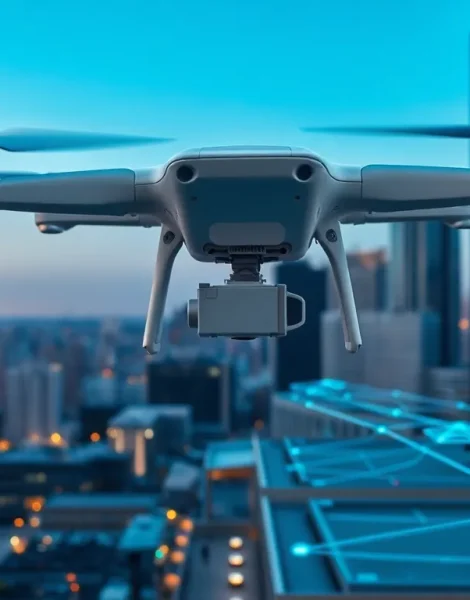
Drone trends 2026 point to a year of significant progress across multiple industries. From autonomous flight systems to commercial delivery networks, drones are set to reshape how people move goods, monitor infrastructure, and travel through cities. The global drone market continues to expand rapidly, with analysts projecting it will exceed $54 billion by 2030. But 2026 stands out as a pivotal year, new regulations, smarter AI, and cleaner propulsion systems are converging to push drone technology into mainstream adoption. Here’s what businesses, enthusiasts, and regulators should watch for in the year ahead.
Table of Contents
ToggleKey Takeaways
- Drone trends 2026 mark a pivotal year as AI-powered autonomous flight, commercial delivery networks, and urban air mobility converge toward mainstream adoption.
- Advanced AI enables drones to detect obstacles, adjust flight paths, and identify specific objects in real-time—transforming industries like agriculture, insurance, and energy.
- Commercial drone delivery from Amazon, Walmart, and Zipline will expand significantly, offering sub-60-minute deliveries to millions of U.S. customers.
- Urban air mobility takes flight with eVTOL aircraft entering commercial service, potentially reducing 90-minute car trips to just 15 minutes by air.
- New FAA regulations, including beyond-visual-line-of-sight (BVLOS) rules and Unified Traffic Management systems, will unlock large-scale commercial drone operations.
- Solid-state batteries and hydrogen fuel cells are advancing drone sustainability, enabling longer flights with lower carbon footprints than traditional delivery vehicles.
AI-Powered Autonomous Flight Systems
Artificial intelligence sits at the core of drone trends 2026. Manufacturers are embedding advanced machine learning algorithms directly into drone hardware, enabling real-time decision-making without constant human oversight.
These AI-powered systems can detect obstacles, adjust flight paths, and respond to changing weather conditions within milliseconds. Companies like Skydio and DJI have already demonstrated drones that track subjects autonomously through dense forests and urban environments. By 2026, these capabilities will become standard features rather than premium add-ons.
Computer vision technology is also advancing quickly. Drones will identify specific objects, damaged roof tiles, missing crops, even individual wildlife, without human operators reviewing footage afterward. This shift matters for industries like agriculture, insurance, and energy, where inspection costs run into billions annually.
Swarm intelligence represents another breakthrough. Multiple drones can now coordinate tasks collectively, sharing data and dividing workloads efficiently. Search-and-rescue operations, large-scale mapping projects, and agricultural monitoring all benefit from swarm coordination. The AI handles communication between units, ensuring safe distances and optimal coverage patterns.
Privacy and security concerns do accompany these advances. Autonomous drones collecting data raise questions about surveillance and data ownership. Industry groups are working with regulators to establish clear guidelines before widespread deployment begins.
Expanded Commercial Delivery Networks
Commercial drone delivery moves from pilot programs to operational reality in 2026. Amazon, Walmart, Wing (Alphabet’s drone division), and Zipline have spent years testing delivery systems. Now they’re scaling up.
Zipline currently operates in seven countries, delivering medical supplies and consumer goods. The company plans to expand its U.S. presence significantly, targeting suburban and rural areas underserved by traditional logistics. Their drones can carry packages up to 4 pounds and travel 100 miles on a single charge.
Amazon Prime Air received FAA approval for expanded operations in 2024. By 2026, the service expects to reach dozens of metropolitan areas. Delivery times under 60 minutes become realistic for millions of customers. This represents a major shift in e-commerce expectations.
Drone trends 2026 also show growth in specialized delivery segments. Pharmaceutical deliveries, organ transport, and emergency supply drops during natural disasters all use drone networks. These applications often succeed first because traditional logistics fail to meet urgent timelines.
Challenges remain. Weather disruptions, airspace congestion, and public acceptance all affect rollout speed. Noise complaints from residential areas have slowed some pilot programs. Companies are investing in quieter propeller designs and flight paths that avoid dense housing during sensitive hours.
Advanced Urban Air Mobility Solutions
Urban air mobility (UAM) transforms from concept videos to actual passenger services in 2026. Electric vertical takeoff and landing (eVTOL) aircraft, essentially large passenger drones, are entering commercial operation in select cities.
Joby Aviation, Archer, and Lilium have all progressed through certification processes with aviation authorities. These companies plan initial routes connecting airports to city centers, bypassing ground traffic entirely. A trip that takes 90 minutes by car could shrink to 15 minutes by air.
The 2028 Los Angeles Olympics serve as a deadline driving development. Multiple eVTOL operators aim to launch services in Southern California before the games begin. This creates intense competition and rapid iteration on vehicle designs.
Infrastructure requirements are substantial. Vertiports, essentially helipads designed for eVTOL aircraft, need construction in urban centers. Real estate developers and city planners are already designating rooftop spaces and parking structures for conversion.
Drone trends 2026 indicate ticket prices will initially target business travelers and premium customers. A typical air taxi ride might cost $100-200 for short urban routes. Operators project costs will drop as manufacturing scales and battery technology improves. Within a decade, air taxis could compete with ride-sharing services on price.
Noise remains a concern for urban deployment. Manufacturers are testing blade designs and flight patterns that minimize sound impact on neighborhoods below.
Evolving Regulations and Airspace Integration
Regulations determine how fast drone trends 2026 actually materialize. The FAA, EASA (European Union Aviation Safety Agency), and other authorities are finalizing rules that enable widespread commercial operations.
Remote ID requirements took effect in the U.S. in 2023, requiring most drones to broadcast identification and location data. This foundation enables more advanced airspace integration. By 2026, regulators plan to carry out beyond-visual-line-of-sight (BVLOS) rules that allow drones to fly long distances without a human observer watching constantly.
Unified Traffic Management (UTM) systems are emerging to coordinate low-altitude airspace. These digital platforms track drone positions, approve flight plans, and prevent collisions, similar to air traffic control for manned aircraft. NASA, the FAA, and private companies like AirMap have developed prototypes now moving toward operational status.
International harmonization presents ongoing challenges. A drone legal in Germany might face restrictions in France. Cross-border commercial operations require bilateral agreements that take years to negotiate. Progress is happening, but slowly.
Liability frameworks also need clarification. When an autonomous drone causes damage, determining responsibility between manufacturers, operators, and software providers gets complicated. Insurance products specifically for drone operations are expanding to address these questions.
Sustainability and Electric Propulsion Innovations
Environmental considerations shape drone trends 2026 significantly. Battery technology advances enable longer flights with lower carbon footprints compared to traditional delivery vehicles or helicopters.
Lithium-ion batteries remain dominant, but solid-state batteries are entering production. These offer higher energy density, meaning more flight time per kilogram of battery weight. Companies like QuantumScape and Solid Power are scaling manufacturing for automotive applications, with drone applications following closely.
Hydrogen fuel cells represent another propulsion option gaining traction. They offer longer range than batteries alone, particularly for larger cargo drones. Hyzon Motors and Plug Power are developing lightweight fuel cell systems specifically for aerial platforms.
Solar-assisted drones extend mission duration for surveillance and communications applications. High-altitude pseudo-satellites, drones that stay aloft for weeks or months, can provide internet connectivity to remote areas without satellite infrastructure.
Drone trends 2026 show manufacturers prioritizing recyclable materials and sustainable production processes. Carbon fiber components, biodegradable plastics for consumer drones, and reduced rare earth mineral usage all feature in new product lines.
The carbon math generally favors drones over ground vehicles for many delivery applications. A small electric drone delivering a package produces fewer emissions than a delivery truck making the same trip, especially in urban areas with heavy traffic.


